
PROCESS SAFETY
OUR SERVICES
- Compatibility Study
- Preliminary Hazard Analysis (PHA)
- Hazard and Operability Study (HAZOP)
- Failure Mode and Effect Analysis (FMEA)
- Hazard Analysis and the Critical Control Points (HACCP)
- Fault Tree Analysis (FTA)
- Quantitative Risk Assessment (QRA)
- Risk Management Plan (RMP)
- Inherent Safety
- Consequence Analysis for Events with Flammable and Toxic Chemicals
- Equipment and Process Plants Reliability Studies
- Control of Static Electricity in Chemical Plants
- Training and Information Courses in the Risk Assessment and Management Techniques
- Safety Integrity Level (SIL) Assessment
- Layer of Protection Analysis (LOPA)
Consequence Analysis for Events with Flammable and Toxic Chemicals
By means of specific models it is possible to estimate the extent and the behavior of gas clouds dispersion, liquid spills or jets, over-pressure waves generated by explosions and thermal radiation levels caused by fires. Some of the usual models are:
a- DEGADIS is a model developed by the U.S. Environmental Protection Agency (EPA) to predict the dispersion of instantaneous, transient or steady-state regimes of dense gas emissions. The model is useful to determine hydrocarbons flammability limits and toxic gas concentrations produced by single sources over flat ground, for a given weather condition;
b- The model for contained pool fire was developed by the Gas Research Institute (GRI) and includes two calculation modules, both for circular or rectangular dikes: (1) radiation calculation as a function of the distance or distance calculation to specified radiation levels; (2) temperature rise calculation of a structure in the vicinity, such as a tank or an adjacent platform;
c- The BLEVE model is based on the Hymes’ punctual source model, as described in the RMP Offsite Consequence Analysis Guidance (U.S. E.P.A. – May 1996). The model allows calculating thermal radiation levels at specified distances, the distance at specified radiation levels and the total radiation dose as a function of the exposure time;
d- The multi-energy explosion model was developed by T.N.O. – a safety and environmental research institute located in Holland. Considers the explosion strength variability, expressing the explosion as a number of charges (fuel-air), each of them with individual characteristics. Modeling the vapor cloud explosion as a number of smaller explosions, each of them centered on confined sections of the cloud, we have a more appropriate model to estimate damage at close distances;
Based on the extent and behavior achieved for the hazardous events in the simulation stage, and on the exposed population’s vulnerability (walkers, local residents, vehicles passengers, employees of other companies), it will be estimated the fatality probability (death) related to the facility distance and the damage level in the facility itself. The following values are used as reference for consequence assessment:
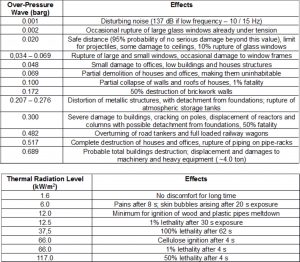
For assessment of acute intoxication cases and/or lethality by chemical exposure, the values of STEL (Short-Term Exposure Limit), IDLH (Immediately Dangerous to Life and Health) and LC (Lethal Concentration) are adopted. Depending on the results achieved with the simulations, it is possible to investigate the chance of domino effect occurrence and its additional consequences.